It can be incredibly frustrating to see faster, gigabit-capable broadband available just around the corner while your connection lags behind. But broadband availability often changes street-by-street-and sometimes even house-by-house-because of how modern networks are built and upgraded.
It rarely comes down to random choice; it's usually dictated by the physical infrastructure beneath the pavement and complex legal factors.
1. The infrastructure beneath your street isn't identical:
Not all streets were built at the same time or in the same way. When providers upgrade a street to full-fibre, availability heavily depends on:
- The condition of existing underground ducts and telegraph poles.
- The distance from the nearest active network cabinet.
- Clear routing: Whether open routes already exist to pull new fibre-optic cables through without digging. (If a street has collapsed underground pipes, it becomes much more expensive and time-consuming to upgrade than the street next to it).
2. Full-fibre rollout happens in targeted phases:
Building a brand-new network across the UK doesn't happen overnight. Providers usually:
- Upgrade towns and streets in planned, manageable phases.
- Prioritize areas where existing ducts make access easier and faster.
- Expand outward systematically from existing fibre routes. (This is why one end of a long road might be completed and connected months before the other).
3. Legal permissions and 'wayleaves':
Sometimes the physical engineering is easy, but the paperwork is hard. Connecting a specific street or building often requires:
- Local council approval for roadworks, digging, and road closures.
- Wayleave agreements: Legal permissions from private landowners to run cables across their property.
- Freeholder consent, which can delay rollout for specific private estates.
4. Flats and shared buildings add complexity:
If your street includes apartment blocks or mixed-use buildings (often called Multi-Dwelling Units), installation is much more complex than wiring a standard terraced house. Providers need bespoke building plans and joint agreements from landlords or management companies, which can pause the rollout for those specific buildings even if the rest of the street is live.
5. Alternative networks and provider coverage:
The UK market now features many alternative fibre networks ('altnets') alongside major national infrastructure. These networks often:
- Target specific local patches or new-build developments first.
- Avoid complex or cost-prohibitive builds in the short term.
- Roll out where they anticipate high customer demand. (This explains why you might have different provider options than someone living in the next postcode).
Will my street eventually catch up?
In most cases, yes-but timelines vary. The UK is actively driving toward nationwide gigabit coverage. Rollout plans frequently evolve as old infrastructure is repaired, permissions are finally granted, and new providers enter your area.
What can I do if my street currently has fewer options?
If you are waiting for an upgrade, you can:
- Register your interest directly with providers like V4 Consumer.
- Encourage your neighbours to do the same to demonstrate high local demand, which can sometimes speed up network planning.
- Check availability regularly, as the UK network map changes almost daily.
UK Infrastructure Timeline: 2024 to Present
The rollout has moved at a blistering pace over the last two years. Here is how the UK reached its current standing:
2024: Scaling and Rural Expansion
- January 2024: Gigabit-capable connections reached 78.5% of UK premises.
- November 2024: The UK hit 85.5% gigabit availability, meeting the 2025 government target ahead of schedule.
2025: Major Milestones
- Northern Ireland Leads the Way: In May 2025, Northern Ireland became the first region to hit a 90% Full Fibre milestone.
- The Tipping Point: By November 2025, Full Fibre (FTTP) connections officially overtook Part-Fibre (FTTC) in the UK market for the first time in history.
2026: The 'Final Push'
- Better Service Operations: As of April 2026, Openreach has revamped its internal structure to specifically reduce delays for "complex" home installations (like blocks of flats).
- New Tools for Residents: On 13 March 2026, the Government launched a new Gigabit Address Checker on GOV.UK, allowing residents to see exactly when their specific postcode is due for an upgrade.
- Current Standing: On 17 March 2026, Ofcom confirmed that Full Fibre now reaches 78% of the UK (25 million premises) and is on track to hit 96% by 2027.
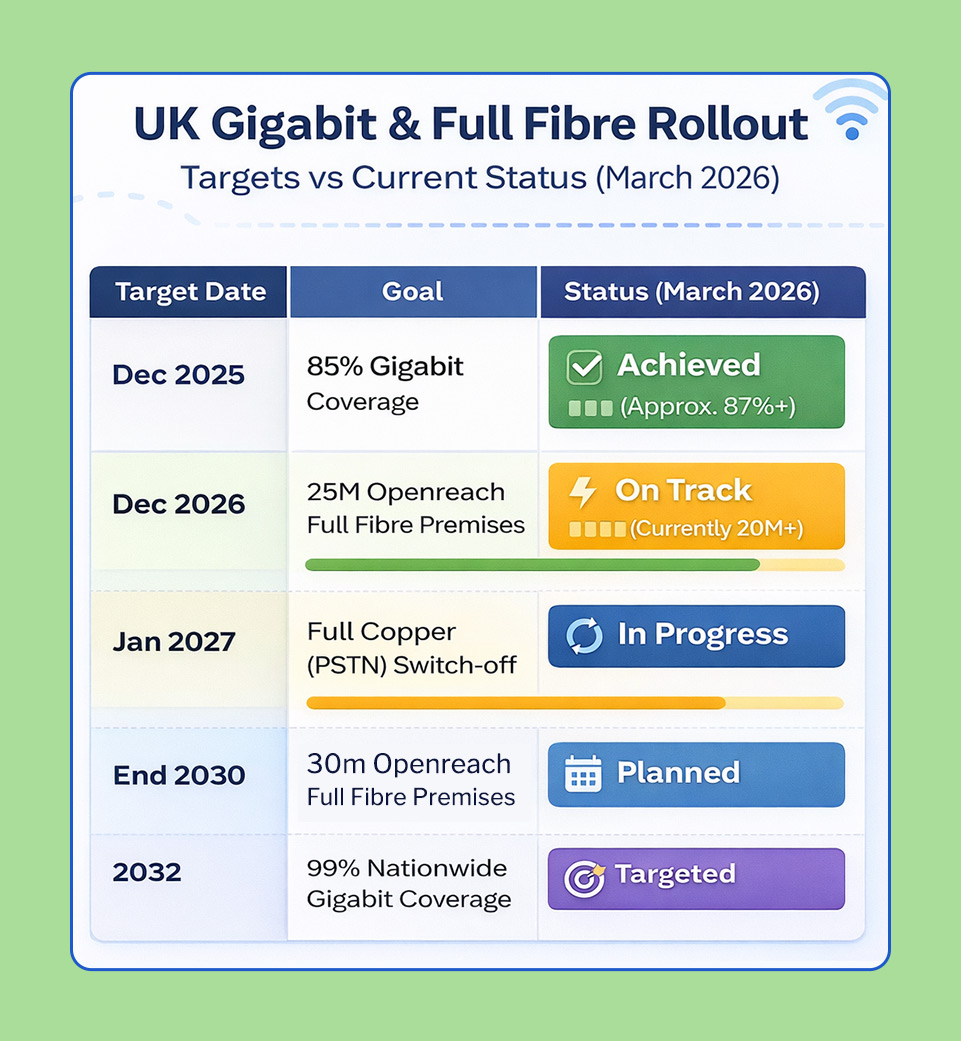
The 'Copper Sunset': Why you need to act soon
The most significant change in 2026 is the Copper Sunset. The old copper network (PSTN) is being retired to allow the UK to focus entirely on fibre-optic technology.
The Deadline: The old copper network is slated for a final switch-off by January 2027. If your street hasn't been upgraded yet, it is now being fast-tracked to ensure you aren't left without a connection when the old lines are retired.
The key takeaway
Broadband availability differs locally due to engineering quirks, complex legal permissions, and phased rollout plans. Checking your exact address is always the most reliable way to see what’s available to your home right now.