Mid-contract price rises occur when broadband providers increase your monthly bill while you are still within a fixed-term agreement.
At V4 Consumer, we believe in transparency. Understanding why these happen helps you manage your household budget and know exactly what to expect.
The simple answer
Historically, mid-contract price rises have been caused by inflation-linked clauses written into contracts. These allowed providers to increase prices annually in line with the rising cost of living.
However, as of January 2025, new UK regulations have changed how these rises must be presented to you.
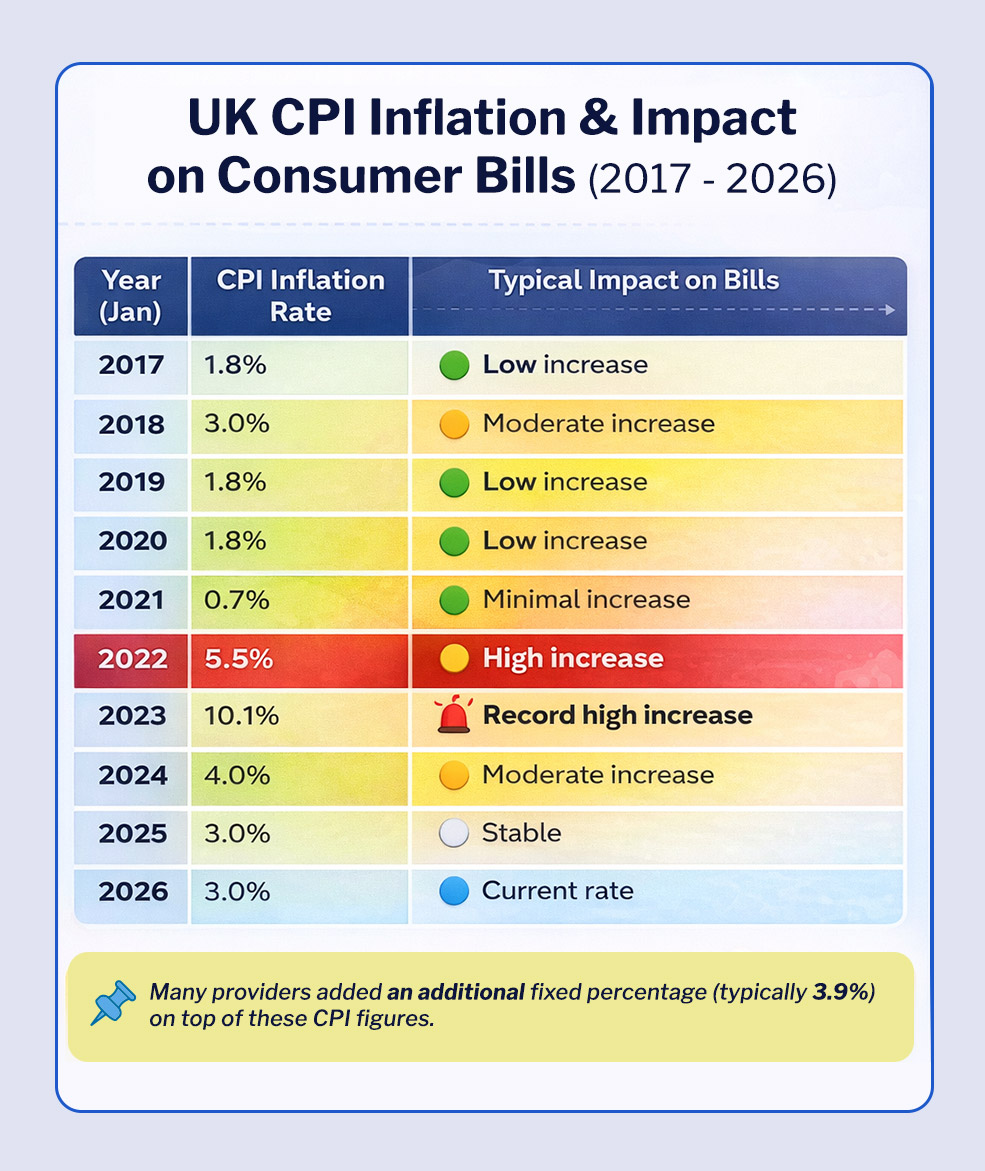
1. 10-Year UK Inflation Report (CPI)
Most providers traditionally used the January CPI figure (published in February) to calculate price rises for the following April. Below is the annual CPI inflation rate for the last 10 years to show how volatile these figures can be.
2. The New "Pounds and Pence" Rule (2025/26)
In a major win for UK consumers, Ofcom introduced new rules on 17 January 2025.
- The Old Way: Providers used confusing percentages (e.g., "CPI + 3.9%").
- The New Way: For any new or renewed contract, providers must now state the price rise in pounds and pence upfront.
For example, instead of saying your bill will rise by "inflation," your contract will now clearly state: "Your monthly price will increase by £3.00 in April every year." This provides the certainty that V4 Consumer customers value.
3. Why do these rises happen at all?
Providers may justify annual increases due to:
- Infrastructure Maintenance: Keeping the UK's fibre network running 24/7.
- Network Upgrades: Investing in the ongoing rollout of Full Fibre (FTTP) across the country.
- Operational Costs: Rising energy prices for data centres and increased staffing costs.
4. Why "Fixed Term" doesn't always mean "Fixed Price"
It is a common point of confusion in the UK market:
- Fixed-Term: You are committed to the provider for a set period (e.g., 24 months).
- Fixed-Price: The monthly cost is guaranteed not to change.
Unless your contract explicitly states it is a "Fixed-Price" deal, an annual increase is likely built into the terms and conditions you agreed to at sign-up.
5. Can I leave without paying exit fees?
Under Ofcom regulations, you can usually leave penalty-free only if:
However:
- The price rise was not clearly disclosed when you signed up.
- The increase is higher than what was specified in your contract.
- Your provider makes a "materially detrimental" change to your terms without giving you 30 days' notice.
If the rise was pre-agreed in your contract (either as a fixed amount or the old inflation model), exit fees will typically still apply.
6. How to protect yourself
- Check the Contract Summary: Don't just look at the "headline price." Look for the section titled "Price Changes."
- Look for Fixed-Price Deals: Some V4 Consumer packages or "Social Tariffs" offer price certainty for the duration of the term.
- Factor it in: When comparing deals, always assume the price will rise by roughly £2–£4 per month after the first year.
The key takeaway
While inflation-linked percentages are being phased out in favour of clearer pounds and pence amounts, mid-contract rises remain a standard part of the UK telecoms industry.
By checking the 10-year CPI table above, you can see why the regulator moved toward "fixed" increases to protect you from the unpredictability of the economy.